Ask a fund manager's finance team how much cash sits across its structures, and you will usually get the figure from the administrator's last report, already a few days old. A real Monday-morning number means calling the administrator, logging into several bank portals and trusting a spreadsheet that was only right on Friday.
The balances themselves are not the difficulty: every bank updates them overnight and many during the day. The difficulty is that in a delegated model the administrator usually holds the connection to those banks. It receives the statements in its own systems and passes the result to the manager as a report, at its own cut-off and in its own format. The manager therefore often learns about the funds it runs second-hand, even though it decides how their cash is used.
Two perimeters, one manager
Most managers have two kinds of accounts to keep track of, and they work quite differently: the management company's own, which the manager runs itself, and those of the funds it runs, where the work is shared with the administrator and the depositary. Who holds the bank connection matters in both.
The first is the management company's own money, and its partners'. Fees coming in, salaries and rent going out, plus the carry and co-investment vehicles through which the partners and the team invest alongside the funds. The team behind it is small and in-house, and has no reason to need anyone else's system to know where its own money stands.
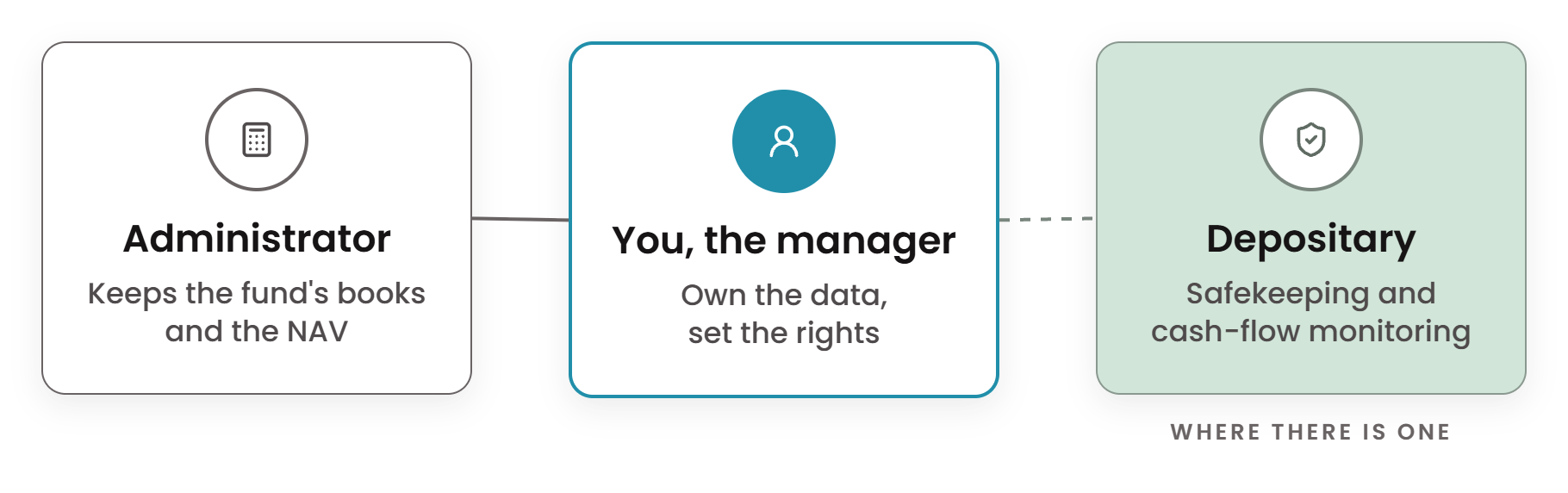
The second is the funds themselves and everything around them: feeders, masters, parallel funds and SPVs, spread across banks and currencies. Here the work is shared. The administrator runs capital calls and distributions and books every investment, exit and expense. The depositary monitors the cash flows. The AIFM, whether the manager itself or a third-party ManCo, remains responsible for oversight, whatever tasks it delegates. The manager decides when to call capital and when to distribute, but learns the outcome through the administrator's reporting. For managers of liquid funds, cash sits mostly with the depositary bank rather than across many banks, yet the dependence on someone else's reporting is the same.
Who should hold the bank connections?
Both perimeters end up producing the same thing: bank statements, all of which the manager is entitled to, whoever handles the accounts day to day. Entitlement to see a statement is not the same as holding the mandate to move the money behind it. But a manager that is already on the mandate, or is added to it with rights to view and prepare payments rather than release them, can hold the connection itself. So the connection does not have to sit with the administrator alone. It can sit with the manager, with the administrator working through it, or each side can hold its own and link the two.
None of that changes who does what. The administrator still keeps the books, the depositary still does its monitoring, and neither has to work any differently. What changes is the direction in which the data travels, and both gain from it: the same structured bank data reaches their own systems, and the depositary's cash-flow monitoring runs on the same feed as the administrator's books rather than on a reconciliation chain it does not control.
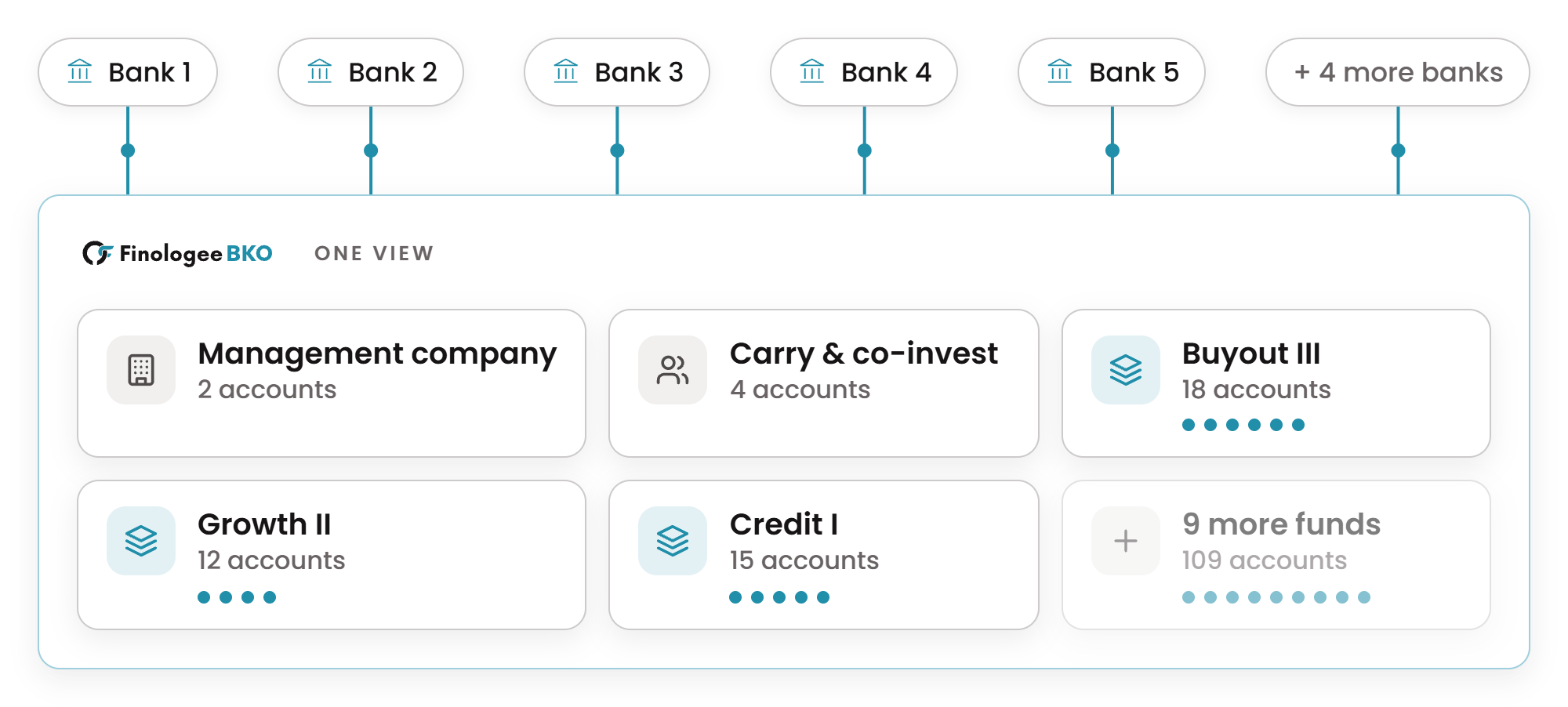
The manager connects each of its banks once, to a layer it controls, and from then on sees every account of every entity in one place, by fund, by vehicle or across the whole group. The administrator gets access to the accounts it looks after, with exactly the rights its role requires, while the depositary can be given the view it needs for its monitoring. A change of administrator no longer means losing the history, and a new bank simply adds its accounts to the same view. And the manager's own team can see for itself whether Friday's distribution went out.
From the screen into the systems
A consolidated view on a screen is useful, but the more valuable part is that the same data flows straight into the systems that actually run on it. Whichever systems exist, whether fund accounting, the management company's ERP, an accounts-payable tool or a treasury system, receive it as camt.053, MT940 or CSV files, or through an API, at the pace each one needs. Nothing is re-keyed, so no figure can be mistyped on its way from the bank into those systems. By Monday morning, the payments made through the platform are already matched to the statement lines that settled them, which leaves the accountants free to get on with the books.
That last step is where most of the accounting effort sits. Cash moves through a loop shared by the manager, the administrator and often a depositary: payments are prepared, approved and executed, then matched and booked, and booking is only as easy as the preparation allowed. A payment prepared on the platform carries its entity, counterparty, purpose and supporting documents. Where the platform is connected more deeply to accounting and operational systems, that context can be retrieved and fed into them along with the statement line, so the accountant sees what each payment was for as well as when it settled.
Carry and team co-investment: the manager's own flows
The clearest example is the set of flows that belong to nobody but the manager. A carry vehicle or a team co-investment programme involves dozens, sometimes hundreds, of individuals who pay in and are paid out in tranches over several years. Each is a counterparty who must be identified, screened and kept current. In practice, every round means the same manual routine: instructions are built in a spreadsheet, then keyed into a bank portal or handed to an administrator to key. The manager who already signed them re-checks them, and incoming amounts are matched against expectations by hand. With hundreds of payees and amounts that differ by tranche, one transposed digit or one outdated account number is enough to pay the wrong person, and getting the money back is rarely quick.
Run on the manager's own layer, the mechanics are those of a capital call. Participants are onboarded with each round: name, tranche, expected amount, currency and reference. Distributions are prepared as a single batch and approved under the manager's own rules on who signs and at what thresholds, by amount, currency and destination. They are then released to each bank and followed through to settlement. Every step sits in one audit trail that the manager can put in front of its partners and auditors, and the finance team knows the state of the programme without asking anyone.
What owning the data changes
For the manager, two things change. It decides on its own figures: a cash position for every fund and vehicle, taken from the banks' statements at the start of the day. The same data feeds its own accounting, management reporting and cash analysis by fund and by deal, which are otherwise rebuilt by hand, if at all. And far fewer payments pass through human hands without a safeguard.
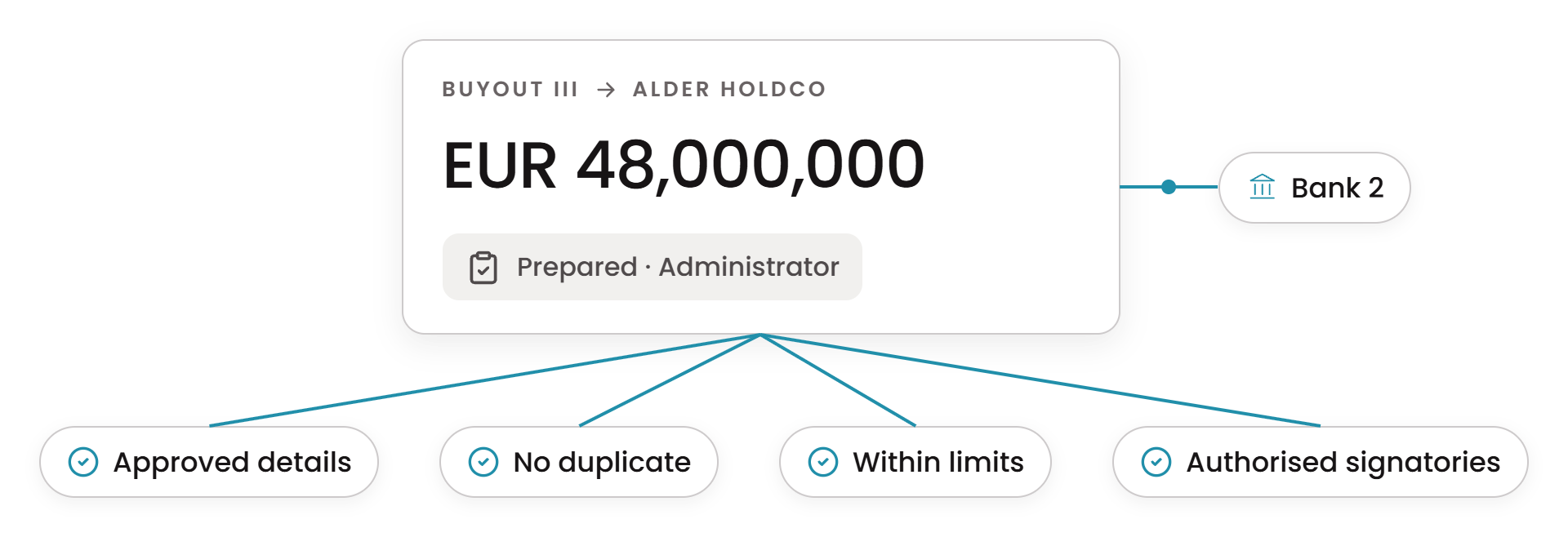
Payment errors usually start before anyone approves anything: an amount copied from a spreadsheet into a bank portal, an account number taken from an email, a batch released twice. Fraud uses the same gaps, most often through an email announcing new bank details. On the platform, a new counterparty or a change of bank details takes effect only after four or more eyes have approved it. Approval rights are set person by person and entity by entity, split between the manager and the administrator, with the depositary in the chain where the parties want it. Every payment is then checked against the approved details and for duplicates before it reaches the bank.
What the Banking Orchestrator does
Finologee's Banking Orchestrator (FinologeeBKO) is the layer described above. It connects to the banks the manager already works with, over SWIFTNet or through direct connections. Mandates, counterparties and account structures stay exactly as they are, and no fund accounting system, ERP or TMS gets replaced. It feeds those systems the bank data, makes the payment details behind each transaction available through its API, and leaves the booking to the administrator's or the manager's accounting system.
Payments run under approval chains defined entity by entity: the manager's own rules for its own vehicles, and rules agreed with the administrator for the funds. Capital calls and distributions can be prepared and released on the platform by whoever runs them, with the manager following each one to settlement. Idle cash is concentrated and redeployed by rule, fund by fund, with four-eyes approval on each rule. Signatory rights and access are managed inside the platform by whoever holds it, manager or administrator, for its own team and for whichever other parties it chooses to work with on the platform. The platform is operated from Luxembourg by Finologee, a regulated Support PFS certified to ISO/IEC 27001:2022.
FinologeeBKO can be set up in three ways.
Three ways to set it up
- 01The administrator puts it in placeThe administrator puts it in place for its client base and the manager gets a portal limited to its own funds, with a current view of positions and the payment pipeline, plus the right to approve whatever it chooses to approve.
- 02The manager holds the platformThe manager holds the platform itself and gives its administrator access to the accounts that administrator looks after, so the administrator keeps working inside the manager's own set-up exactly as before.
- 03Each side holds its own, linkedThe platform also lets each side hold its own set-up and link them. A manager that keeps its management company and carry vehicles on its own set-up, while its funds sit on the administrator's, still gets one consolidated view across both, and neither side re-enters what the other already holds.
Which of the three a manager ends up with usually comes down to how much of the operating work it has kept in-house.
Why now: more regulation, more outsourcing, more structures
There is a regulatory case for doing this now. AIFMD II raises what a manager has to show about the delegates it oversees. For funds that invest in illiquid assets, depositaries are expected to check each acquisition before the payment for it is instructed. Both are easier to meet when the manager, the administrator and the depositary work from the same data.
The more practical case is the one every finance team already knows: more of the fund accounting is being outsourced, and outsourcing more is exactly when owning the underlying data starts to matter.
Structures keep multiplying, but the number of firms servicing them does not. The manager's own cash data is the one asset in the whole arrangement that nobody else has a reason to pull together on its behalf. Monterey Insight's 2026 Luxembourg Fund Report puts numbers on both: in the year to December 2025, alternative fund umbrellas in Luxembourg grew by 14% to 8,765, while the number of third-party administrators servicing them stayed at 118, so each one services more structures every year. Administrators have as much reason as managers to want the bank data to arrive structured.
More structures, the same number of administrators
8,765alternative fund umbrellas in Luxembourg, up 14% in the year to December 2025
118third-party administrators servicing them, unchanged
Source: Monterey Insight, 2026 Luxembourg Fund Report.
The Monday morning question does not go away, but the answer comes from the manager's own screen, at the start of the day, with the administrator's books and the depositary's monitoring running on the same data underneath.
To see how this works across fund structures, see the Banking Orchestrator for funds page or take one of the guided tours.